
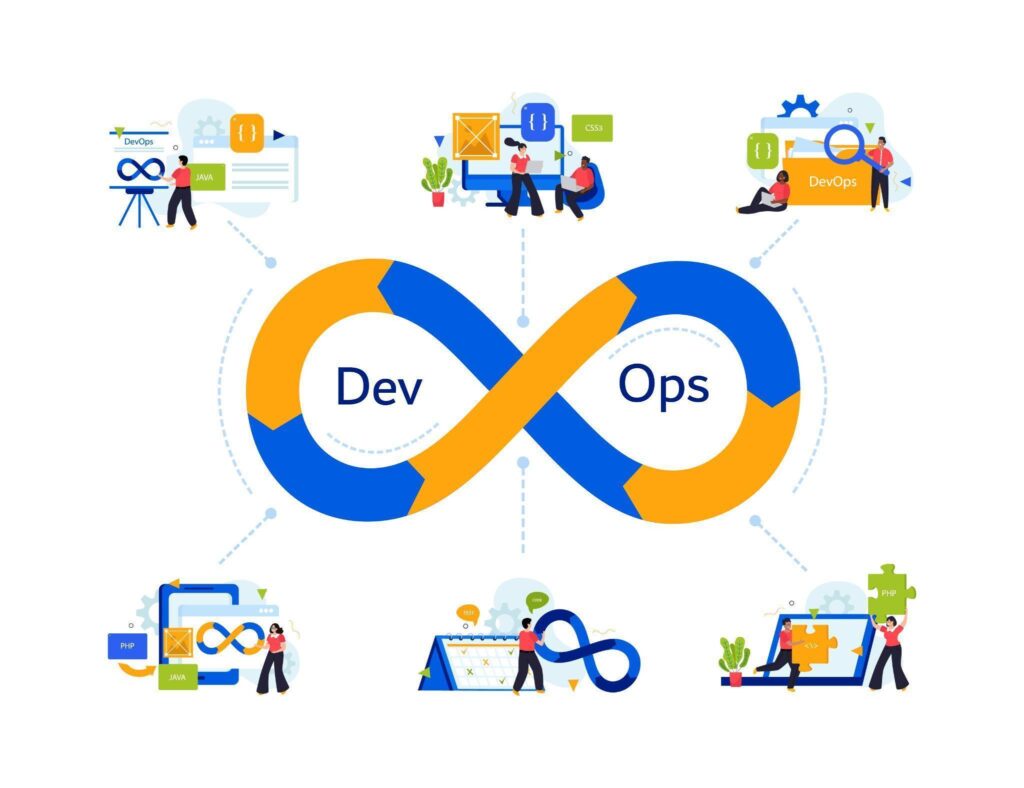
The modern business landscape is changing at lightning speed, and to stay ahead of the competition, companies need more than just high-quality products or services. Product release speed and service stability are critical to competitiveness today. When it comes to enterprise business, this segment simply cannot afford long development cycles, frequent release errors, or complex processes for cross-team collaboration. Today, more and more large organizations are turning to DevOps consulting, an approach that integrates development, testing, and operations into a single, efficient system. But does your business really need DevOps? Read on to learn why DevOps consulting is so important today and how this methodology can transform your company.
What Is DevOps Consulting and Why Is It Important for Enterprise Companies?
DevOps is a set of practices and tools designed to solve real-world problems. The key goal of this methodology is to automate and accelerate the processes of software development, testing, and deployment, ensuring secure, fast, and seamless releases. In addition to DevOps consulting, modern companies also need AI consulting services to optimize complex processes, improve decision-making, and uncover the transformation opportunities hidden within their data.
DevOps consulting refers to expert services designed to improve software development, testing, and deployment processes. Its essence lies in the fact that external specialists help enterprise companies adopt the DevOps methodology to automate infrastructure, unify development and IT operations teams, and accelerate time-to-market.
Key Challenges Faced by Enterprise Companies without DevOps
The Disconnect between Development and Operations Teams
At first glance, it might seem like this isn’t really a problem, but that’s not the case at all. If we consider the traditional model, developers write the code, hand it over to the operations team, and that’s when the problems begin. For example, the necessary documentation might be missing, the code might be incompatible with the IT infrastructure, or the product’s business logic might be lacking. Fixing these issues takes a lot of time, and it’s often difficult to pinpoint who is responsible for the failures. DevOps helps bridge this gap by unifying development and operations into a single ecosystem, resulting in a high-quality, stable product.
Product Quality Issues
When a company’s development and operations processes are not synchronized, errors typically surface at later stages, and correcting them takes a significant amount of time and resources. As a result, users experience unstable service performance, which significantly undermines the company’s reputation and customer trust.
Slow Release of Updates
For companies that still cling to the traditional approach to software development and operations, the process of deploying new software versions is quite complex. A lot of time is spent on testing and approval, and the implementation of updates comes with a high risk of rollbacks and failures. As a result, the enterprise loses flexibility and cannot respond quickly to market changes.
A Step-by-Step Roadmap for Implementing DevOps in a Company
It is important to understand that implementing DevOps in an enterprise company is not a one-time technical update that will solve all problems and meet all needs. It is a comprehensive transformation of processes, IT infrastructure, and team collaboration. A phased roadmap is the best solution for enterprises to make the transition as effective and low-risk as possible.
1. Analysis of current processes
This stage involves an audit of the existing IT infrastructure and development processes. It identifies key challenges facing the company, such as a lack of automation, scalability issues, or poor communication between teams. The task of DevOps consultants at this stage is to evaluate team performance and the time required to release new features.
2. Strategy development
It is important here to define the company’s key business objectives as precisely as possible, for example, improving system stability, accelerating product scaling, and so on. In addition, you need to select the necessary technologies and tools, such as monitoring systems, CI/CD platforms, or cloud services.
3. Process automation
This is the foundation of the DevOps approach. Implementing CI/CD pipelines enables companies to test, integrate, and deploy new features faster without relying on manual processes. Enterprises that use automation solutions significantly reduce human error and improve the reliability of their releases.
4. Scaling and cloud integration
Most modern enterprises are transitioning to cloud infrastructure because it provides flexibility and allows for rapid scaling of resources. The task of DevOps consultants is to help build a sound cloud architecture, enhance system security, and optimize resource utilization.
5. Monitoring and continuous improvement
It is important to understand that the DevOps transformation process doesn’t end with implementation. It’s crucial for companies to continuously analyze service stability, release speed, and system performance. Continuous monitoring allows for the rapid identification of problems and the gradual improvement of development processes.
Why AI Consulting Services Are Crucial for Modern Enterprises
AI is revolutionizing industries and enabling businesses to improve decision-making, optimize operations, and drive innovation. However, implementing AI-based solutions can be very complex and time-consuming. AI consulting services offer specialized expertise to help enterprises understand, develop, and implement AI solutions. These services cover a wide range of activities, including strategy development, data analysis, algorithm development, and AI system implementation.
The benefits of AI consulting services include:
- Access to cutting-edge technologies
- Reduced implementation costs
- Customized AI-based solutions
- Enhanced decision-making capabilities
- Competitive advantage
Enterprises should invest in AI consulting services to unlock the full potential of these technologies and take their business to new heights of efficiency and success.
Key Benefits of DevOps Consulting for Enterprises
- Accelerated software development and deployment
- Improved product quality and reliability
- Enhanced communication and collaboration between development and operations teams
- Automation of repetitive processes
- Ability to identify and resolve issues early in the development process
- Seamless scaling of operations
- Reduced time to market
Final Thoughts
Today, DevOps consulting has become a strategic necessity for enterprises seeking to improve the efficiency of their IT processes. A properly structured implementation roadmap is a key to enhancing service stability and reducing operational risks. The integration of AI consulting services is an additional advantage for companies, and when combined with DevOps, they form a foundation for a flexible, scalable, and competitive business.
More Stories
Before You Buy a Two in One Electric Toothbrush
How to Address an International Postal Package Correctly
New platform for the Austrian online gambling market