

Most QA teams don’t fail because they skip testing. They fail because the test cases they write are unclear, outdated, or impossible to maintain at scale. A single test case writing mistake repeated across hundreds of cases creates a mess that compounds over time, and once the backlog of broken or redundant cases grows large enough, teams stop trusting their own test suite.
These mistakes are common. They’re also avoidable. Tools like aqua cloud are built specifically to help QA teams write, organize, and maintain test cases without the usual friction. If you’re writing cases from scratch, the aqua AI test case generator can speed up the process while keeping quality consistent. But tooling only helps if you understand what goes wrong in the first place.
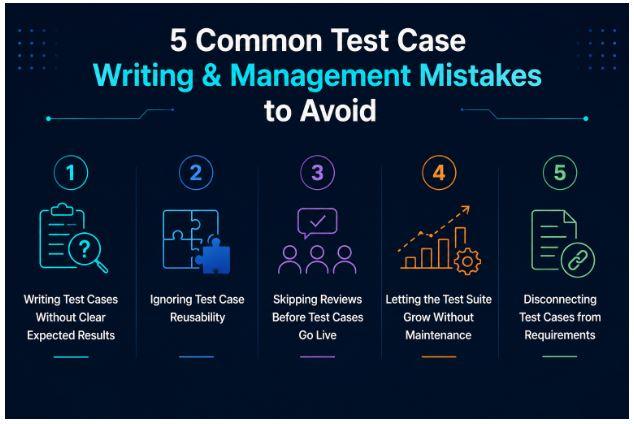
Here are five mistakes worth knowing about before they slow your team down.
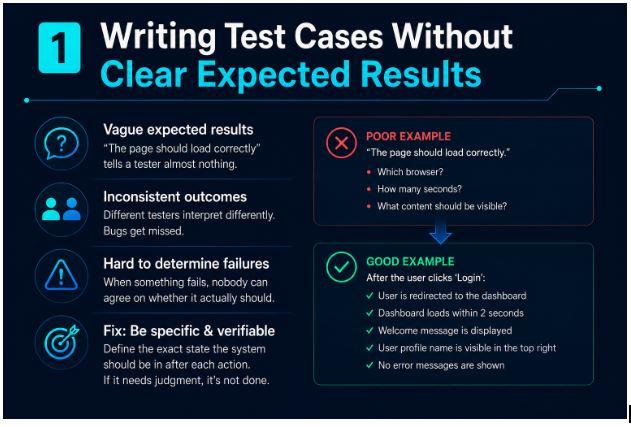
1. Writing Test Cases Without Clear Expected Results
The most basic test case writing mistake is also the most damaging: leaving the expected result vague. “The page should load correctly” tells a tester almost nothing. Load correctly on which browser? In how many seconds? With what content visible?
When expected results are unclear, different testers interpret them differently. Bugs get missed. Test runs produce inconsistent results. And when something does fail, nobody can agree on whether it actually should.
This problem tends to get worse as teams grow. A senior tester might fill in the gaps from experience, but a newer team member has no reference point. The case becomes unreliable depending on who runs it.
Fix this by writing expected results that are specific and verifiable. Define the exact state the system should be in after each action. If the expected result requires a judgment call, it’s not finished yet.
2. Ignoring Test Case Reusability
QA teams often write the same steps over and over across different test cases, with small variations each time. This is a test case management mistake that creates serious maintenance overhead. Every time the underlying feature changes, someone has to track down every case that contains those steps and update them manually. Things get missed. Outdated steps stay in the suite.
The cost isn’t just time. Inconsistencies creep in when the same flow is described differently across multiple cases. One version says “click Login,” another says “submit credentials.” Neither is wrong, but the variation makes cases harder to read and harder to maintain as the product evolves.
Modular test cases solve this. Write common flows, like login or checkout, as reusable components that other cases can reference. When something changes, you update it once.
3. Skipping Reviews Before Test Cases Go Live
Test cases that go directly from writing to execution without any review tend to contain gaps, duplicate existing coverage, or test the wrong thing entirely. The mistakes in test case writing that are hardest to catch are the ones where a case looks complete but actually misses a key scenario.
A short review step, even just one other person reading through a new case, catches most of these problems before they waste anyone’s testing time. Building this into your workflow pays off quickly, especially on complex features where coverage gaps are most likely.
4. Letting the Test Suite Grow Without Maintenance
One of the more common mistakes in test case management is treating the test suite as an archive rather than a working document. Cases get added, features change, and old cases never get retired. The result is a suite full of outdated, redundant, or broken cases that slow down every test cycle and erode confidence in the results.
Schedule regular reviews. Remove cases that no longer apply, update cases that reflect old behavior, and consolidate overlapping coverage. A smaller, accurate test suite beats a large, unreliable one every time.
5. Disconnecting Test Cases from Requirements
When test cases aren’t linked to the requirements they’re meant to verify, coverage becomes a guess. Teams end up over-testing some areas while leaving genuine gaps elsewhere. This is a test case writing mistake that’s particularly costly in regulated industries where traceability between requirements and testing is required.
Linking test cases to requirements from the start makes coverage visible and auditable. It also makes impact analysis faster when requirements change, since you can immediately see which cases need to be updated.
Conclusion
Most QA problems trace back to the same handful of issues: cases that are too vague, suites that aren’t maintained, and processes that skip review. None of these are hard to fix once you see them clearly.
Getting the fundamentals right with how you write and manage test cases means your team spends less time firefighting and more time finding real issues. That’s what good testing is supposed to do.
More Stories
How the CloudySocial Team Organizes Tech Help Content
CsTechHelp CloudySocial Recap: Highlights, Lessons, And What’s Next (2026)
CloudySocial CSHardware Promo Code: How To Save On Gaming Gear In 2026